Position and Ranges: Why the Same Hand Plays Differently Across Positions
Understand 6-Max table action order and how position drives information advantage, pot control, and equity realization. Use heads-up, multi-way, and river range exercises instead of guessing exact single hands.
Author: PokerSlate · Gemini-assisted translation · Editor: PokerSlate primary AI reviewer
Published:
Updated:
Reviewed:
Map Out a 6-Max Table
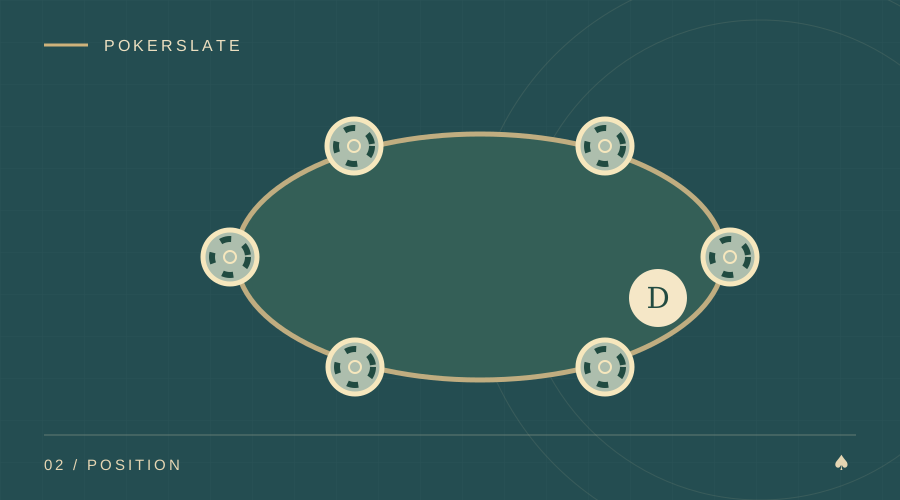
Standard 6-Max table positions in order of preflop action are UTG (Under the Gun), HJ (Hijack), CO (Cutoff), BTN (Button), SB (Small Blind), and BB (Big Blind).
Standard multi-way preflop action starts to the left of the Big Blind. Postflop action starts with the first remaining player to the left of the Button. If the Button remains in the hand, he acts last postflop. The Big Blind acting last preflop does not mean he acts last postflop. In heads-up play, the Button is also the Small Blind, acting first preflop and last postflop—a key exception to memorize.
Position Is Relative to Remaining Players
Saying "I'm in the Cutoff, so I have position" is not always true. If the Button calls your raise, you act before him postflop; if only the Big Blind calls, you act after him. Position must always be evaluated relative to players remaining in the pot.
Paper Exercise: CO raises, BTN and BB call. Postflop order is BB first, CO second, BTN last. CO has position on BB, but lacks position against BTN. Circle remaining players on hand histories rather than relying strictly on seat names.
Where Information Advantage Materializes
Acting first forces you to check or bet without knowing your opponent's action. Acting second allows you to observe that action before deciding whether to call, raise, or fold; if checked to, you can check back to see the next card for free. When checked to, a player acting last can check back and see the next street without paying more; a player acting first cannot guarantee this by checking.
Suppose you hold J♠T♠ on a flop of J♦7♣2♥. If your opponent checks first, you can choose a value bet or check back to preserve medium showdown value. If you act first and check, your opponent can bet, forcing you to face a new price. Your cards are identical, but the decision tree changes completely.
Pot Control Does Not Mean Checking Every Medium Hand
In-position play offers more options, but it does not mean absolute control over your opponent. Betting leaves you open to check-raises, while checking allows draws to improve for free. Define "pot control" as choosing the level of risk to accept based on hand strength and ranges, rather than treating checking as an automatically safe action.
Holding a middle pair on a dry board requires a different plan than holding the same pair on a highly connected board. When reviewing, ask: Which worse hands pay off a bet? Which hands gain free equity if I check? What is my plan if I face a raise?
Transitioning from Hand-Guessing to Range Categories
When an early-position player open-raises, do not assume he holds exact A-K, nor treat all non-premium hands as equal bluffs. Establish an initial range based on position and player tendencies, then narrow or adjust it across flop and turn streets.
Beginners can start with three range categories: Strong Made Hands, Medium Showdown Hands, and Draws/Air. On the river, review which draws completed and which missed. This approach avoids counting individual combo math while forcing you to consider opposing evidence: when you want to call, you must list value hands that bet this way.
Range Exercise: River Decisions on Q-High Boards
Board: Q♣8♦3♠9♦2♥. You hold A♠Q♠. Your opponent might bet weaker Q-x hands, or he might bet two pair and sets; missed diamond draws might be converted into bluffs. The word "might" cannot automatically be converted into "frequently." Assign range weights based on whether your opponent holds these hands preflop and how he played prior streets.
When practicing, test two hypotheses: 1) Opponent rarely bluffs with missed draws; 2) Opponent bluffs a significant portion of missed draws. Compare whether your calling decision changes under each assumption. If it changes drastically, your decision depends heavily on opponent behavior evidence rather than board texture alone.
Equity Realization: Theoretical Equity vs. Realized Payouts
All-in equity with no future betting involved is straightforward to calculate. But when future betting streets remain, you may be forced to fold hands that had live draw equity, or you might extract extra bets when hitting. This makes raw all-in equity and actual played hand value two separate metrics.
Positional advantage helps gather information and select lines, but it does not transform weak hands into profitable calls. Against massive raises, extremely strong ranges, or short effective stacks, position cannot justify ignoring pot odds.
Multi-Way Pots Require Fresh Analysis
Heads-up bluffs require only one opponent to fold; multi-way bluffs require every remaining opponent to fold. Once a player calls, odds and information change for everyone behind him. Never copy heads-up betting frequencies directly into three-way pots.
During practice, reduce marginal plays in multi-way pots, focus on recognizing strong made hands and premium draws, and note how many players act behind you. The goal is simplifying decisions, not claiming bluffs never exist multi-way.
Review Exercises and Answers
- Q1: CO, BTN, and BB see a flop in a 6-Max game. Who acts last postflop? Answer: BTN; CO does not have position on all players.
- Q2: Does checking first guarantee seeing a free turn card? Answer: No, players acting after you can still bet.
- Q3: Does a missed draw on the river prove your opponent is bluffing? Answer: No, you must evaluate if he reaches the river with those draws and whether he actually chooses to bet them.
When reviewing, write down one clear sentence: "What specific extra option did positional advantage give me in this hand?" If you cannot answer, avoid using "I had position" as a justification for wide calls.
Local reading context
Designed for beginner No-Limit Texas Hold'em instruction. Examples use standardized chip units and do not address regional gambling eligibility; exercises are intended for paper or free-play environments.
Related reading and tools
Original sources and verification
- Pokerology · Playing Position
Cross-checks position and action order relationships.
Verified:
- Pokerology · Starting Hand Selection
Cross-checks position, effective stack, and speculative hand parameters.
Verified:
- PokerStars Learn · The Flop and Your Hand
Cross-checks postflop hand categories and board texture classification.
Verified: