Should You Call on the River? Calculate Price First, Then Find Opponent's Bluffs
Facing a big river bet, even top pair might just be a bluff catcher. Using custom hand examples, pot odds thresholds, and range weighting drills, this guide breaks down how to identify bluff catchers, why missed draws aren't automatic bluffs, and how to properly review results.
Author: PokerSlate · Gemini-assisted translation · Editor: PokerSlate primary AI reviewer
Published:
Updated:
Reviewed:
"He Can't Have It Every Time" Is Not a Reason to Call
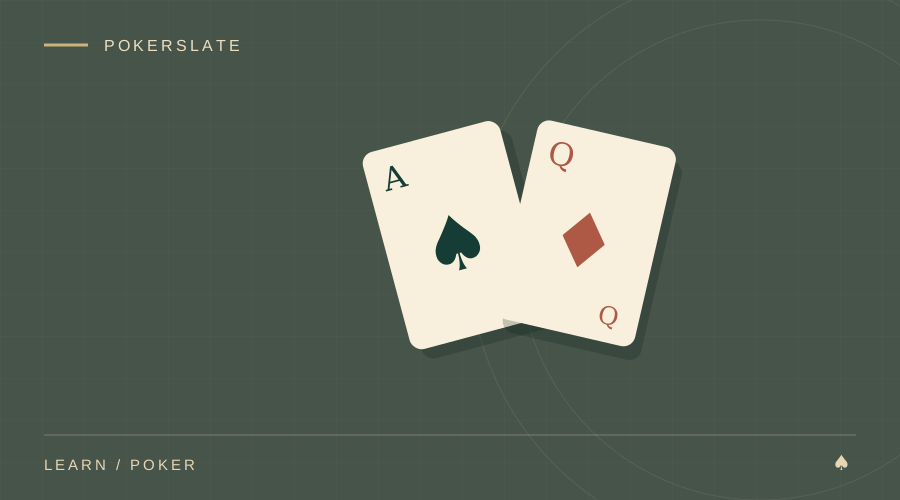
You hold K♣Q♦ on a board of K♠9♥6♥2♣3♦. Your opponent bets the river. You stare at your top pair while a thought loops in your head: "The heart draw missed, he could be bluffing." That thought points out a possibility, but it fails to answer the real question: across all the hands he bets this way, how often do you actually win?
A bluff catcher is a hand that beats all of your opponent's bluffs but loses to all of his value bets. It describes your hand's relationship to your opponent's betting range, not a fixed hand ranking. Top pair can be a bluff catcher; against a weaker value bet, it might be stronger than a pure bluff catcher. You must clarify this relationship before you can accurately calculate price.
Set a Threshold Using River Price
Suppose the pot is 120 before your opponent bets 80, and you must call 80. After calling, the total pot is 280, making your required equity 80 ÷ 280, or roughly 28.6%. If your hand only wins against bluffs—and assuming no split pots, rake, or future action—your opponent's betting range must contain more than 28.6% bluffs for a call to yield positive expected value.
This 28.6% is not a score for "how much his bet looks like a bluff," nor is it a frequency your opponent is required to follow. It simply establishes a threshold for your decision. If you estimate your win rate at 35%, the expected value of calling is 0.35 × 200 − 0.65 × 80 = 18. If your win rate is only 20%, it drops to 0.20 × 200 − 0.80 × 80 = −24. Money already committed to the pot belongs to past decisions and is not an additional cost for this call.
Write Value Hands First, Then Bluff Hands
Returning to the K♣Q♦ example: first check whether your opponent would bet sets, two pair, or stronger K-x hands, then list uncompleted heart draws and other weak holdings. Every category must pass the same filter: would it take this exact line through preflop, flop, and turn, and then choose this river bet size?
Do not simply write down a broad starting range and label all remaining weak hands as bluffs. Certain hands were folded earlier, certain weak hands with showdown value might check, and certain missed draws might choose to give up. You are estimating the range that actually bets here, not every holding your opponent could originally have dealt.
When practicing, list candidate hands first, then assign continuing and betting frequencies. If you are uncertain, keep the uncertainty intact rather than assigning a 100% bluffing frequency to every missed draw just to reach a desired calling conclusion.
Multiply Combinations by Action Frequency
Consider a simplified range exercise that does not map to a real board. Suppose you identify 14 value combinations and 6 bluff candidate combinations, assuming value combinations bet 100% of the time. If all six candidates also bluff every time, the bluff ratio is 6 ÷ 20 = 30%, slightly above our 28.6% threshold.
If those six candidates only bet half the time, their effective weight becomes 3, shifting the bluff ratio to 3 ÷ 17, or about 17.6%. The exact same six candidate hands yield an inverted calling decision purely due to action frequency.
This explains why saying "there are still six missed draw hands" is insufficient. The count of candidate combinations is merely a starting point; frequency determines how many combos actually enter the betting range. Value combinations may not bet 100% of the time either; a thorough review assigns realistic weights to both sides.
Check Blockers on Both Sides
Cards in your hand make certain opponent combinations impossible. This removal effect is called blocking. If your card removes value hands from your opponent's range, it supports calling; if it simultaneously removes hands your opponent would have used as bluffs, it works against you.
Holding a single heart on a board with missed heart draws does not automatically make a bluff catch more profitable. It may reduce the opponent's unmade flush combinations. Which effect dominates depends on specific ranks, value ranges, and betting frequencies. You cannot use "I have a blocker" as an automatic green light.
Beginners can start with a simple exercise: list the candidate value combos blocked by your card, list the candidate bluff combos blocked by it, and compare them. You do not need to leap to precise frequency claims based on a single term.
Three Written Exercises
- Pot is 90, opponent bets 90, you call 90. The threshold is 90 ÷ 270 = 33.3%. If you only beat bluffs and estimate bluffs at 25%, you should fold under these assumptions.
- Pot is 100, opponent bets 50, you call 50. The threshold is 25%. If he has 12 value combinations with a combined weight of 12, plus 6 bluff combinations that bet every time, the bluff ratio is 6 ÷ 18 = 33.3%, yielding positive expected value for a call.
- Continuing from the previous problem: the six bluff candidate combos now bet only half the time. Effective bluff weight is 3, making the ratio 3 ÷ 15 = 20%. At the same price, the decision shifts to a fold.
These exercises use instructional setups; the answers do not prove any real-world opponent uses these exact ranges. Try adjusting the value betting frequency in problem two to 50% and recalculating to see why the conclusion changes.
Making a Wrong Call vs. Making a Wrong Decision
When you call and your opponent turns over a set, it is easy to feel you shouldn't have called. When you fold and your opponent shows a bluff, it is easy to feel cowardly. But a single showdown only reveals what your opponent held this one time; it does not tell you his overall betting frequency.
When reviewing, keep four lines of records: calling threshold, value candidates, bluff candidates, and action weights. Then inspect which assumptions are supported by evidence and which stem from emotion. Pot odds calculators verify price; equity calculators given known hands answer only the specific hand matchup you input, rather than generating a trustworthy unknown range for you.
If the hand occurred in a multi-way pot, or if tournament eliminations and payout jumps significantly alter chip value, perform a separate analysis. These heads-up chip-EV exercises do not solve those scenarios directly.
Local reading context
Applies to heads-up river decision-making in standard No-Limit Texas Hold'em instructional settings. Example calculations ignore rake, side pots, and tournament ICM. Range and frequency settings are designed strictly for practice; do not apply them directly to multi-way pots or payout jumps.
Related reading and tools
Original sources and verification
- PokerStars Learn
Cross-check calling threshold and fundamental river bluff-catching concepts; monetary figures and EV examples in this text are calculated independently.
Verified:
- PokerStars Learn · Pete Clarke
Cross-check range relativity of bluff catchers and distinctions regarding bets with weaker made hands; this text does not reuse source hand examples.
Verified: